I'm headed out to Joshua Tree later today to check out Gram Fest. My husband's band Bucksworth is playing tonight at 9; his other band, Old Brown Shoe, plays tomorrow (we're not sure what time yet).
Joshua Tree is such a surreal place--very lunar, very otherworldly. It will be nice to breathe in that sage-y desert air (unless the smoke from all the wildfires has drifted that way), and soak in some great music.
Friday, September 30, 2005


Thursday, September 29, 2005
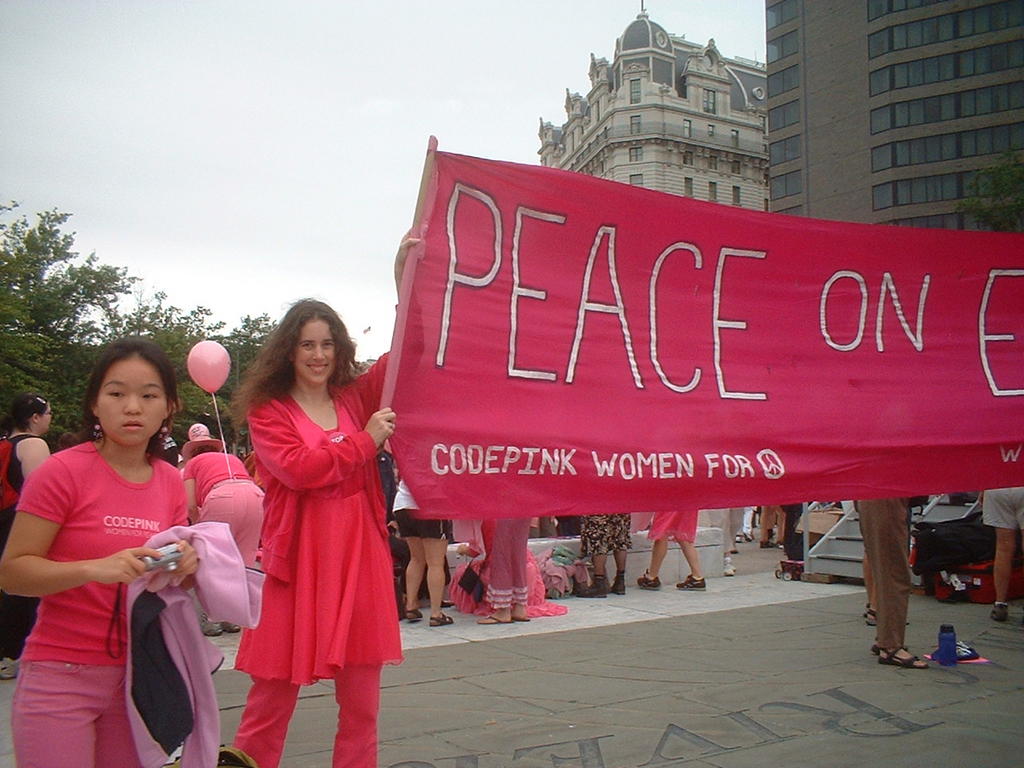
 The fabulous Jodie Evans just sent me this picture (I'm the one on the left, with my jacket falling off)--another great reminder of my time in DC. I don't think my feet have fully reached the ground yet.
I've been thinking today about my last time in DC. I was 18 years old, and had won an essay contest sponsored by the United States Information Agency (there were three American winners and three French winners; the subject of the contest was "The Meaning of Liberty", to celebrate the Statue of Liberty's Centennial. At the celebration, our essays were placed in the time capsule of the statue and we were all named "Stewards of Liberty for the next 100 years." My essay had been about the liberty of the human spirit and imagination; that is the liberty I hope to still steward for the next 81 years!) The winners of the trip were flown to Washington, DC before we headed to NY for the Liberty festivities (with a side trip to Connecticut, where we were the guests of honor at a UN-sponsored Apple Festival.) We were feted all over DC. I have a picture of William Bennet tshaking my hand and handing me some sort of certificate in the Department of Education building. I remember he named me the "Minister of Smiles". If I had known at the time what a conservative hypocrite he was, I wouldn't have been smiling so broadly. Did you hear his comments yesterday about how the crime rate would go down if we aborted all black babies?!!?!! I see the picture of my hand against his and I cringe.
I was so shy as an 18 year old. It was hard for me to ask questions of people, to speak to people at all. We were given an audience with Supreme Court Justice Warren Berger; I remember he smiled at me and said I must have a question for him. I shook my head and stammered no, even though I knew it was an opportunity I was silly to pass up. I found myself staring at the bags under his eyes and wondering what would ooze out if they were sliced open--marshmallow creme, I imagined--instead of allowing my my critical brain to zoom into focus. Later, we had the chance to talk with the Press Secretary under Reagan (I forget his name). I forced myself to ask a question--I said something to the effect of "Do you ever withhold information from the American public?" I was a bit taken aback when he laughed and said "Of course." There was no attempt on his part to sweeten the situation, and this came as a shock to me; I already considered myself a peace activist at that age, but I was still fairly naive, still fairly trusting of those in power. That moment opened my eyes big time.
How cool to return to DC with more awareness, more knowledge, more desire to ask questions, to speak to power. I still struggle with some of that innate shyness, but being surrounded by others asking the same hard questions helps pull me out of my shell, helps make my own voice stronger.
When The Book of Dead Birds came out, I expected a huge debate about my decision to write from the perspective of a different ethnicity from my own. I suppose that was a bit presumptuous of me--the book didn't end up evoking any sort of huge response; it was just a blip on the radar, although it did receive a very warm reception from those who did read it. So, I was both surprised and not when Google Alert brought this to my inbox: my book is going to be discussed at the 2006 Conference of the Society for Muti-Ethnic Studies: Europe and the Americas in Pamplona. Here is the call for panelists:
I was expecting questions like this to rise up--I asked them of myself constantly as I wrote the novel--so I can't be too shocked or hurt by them. Still, I have to admit that it does sting a bit to think of someone calling my work "literary minstrelsy", calling my creative choices an "arrogant presumption." It was so hard for me to come to terms with writing this novel. Those who have read about the evolution of the book know how much I resisted writing about Ava and Helen; when they first came to me, I tried to encourage them to leave. I didn't think I had the right to write their story. I didn't want to be a cultural imperialist, didn't want to claim a story that was not my own. They were so persistent, though, and I finally had to honor them and the story they carried to me. The impulse to write their story was not autobiographical--the impulse to write the poem that ultimately led to the novel was autobiographical, but once I found Ava and Helen, the story no longer had anything to do with me, with my life (or so I thought. Once I finished writing the novel, I realized how much I had in common with Ava, how close she and I were in spirit. But as I wrote, I didn't feel that way at all, wasn't writing from an autobiographical urge; in fact, at first I tried to consciously distance myself by writing Ava in the third person. It was only when I had a high fever and had the experience of slipping under her skin that I realized I needed to write her in the first person. And that was very scary for me, very humbling. I resisted that at first, too, but the story seemed to call for it. And the story did come to life when I began to write in the first person--even though at the time I still didn't see much of myself in Ava.)
I am curious to know how Cathy Waegner came to define me as upper-middle-class. I suppose that label might fit my life now, but at the time I started to write the novel, Matt and I would be lucky to be considered lower-middle-class. And the few years right before writing the novel, we were well below the poverty line. I do admit that I grew up with a priveleged background (I remember in fifth grade or so, my friend Emily asked what class my family was. She said of her own family, proudly, "We're upper middle class." I had never even heard of class before, other than within a school building. When pressed, my parents told me we could probably be considered in the same category as Emily's family, but they seemed uncomfortable talking about it. I remember being relieved that Emily wasn't "higher" than me, but then I thought about all the people who are below "upper", and what their lives must be like, and I felt very guilty. My first twinge of class consciousness.) I've never seen my class labeled in public before, and it feels strange. But I do need to own up to my priveleged status, and how it might affect people's response to my work. And I need to not be defensive about this panel; I need to let people interpret my book, my motives, however they wish to. It is out of my hands at this point.
I doubt I'll have a chance to attend the conference in Pamplona, but it would be very interesting to hear the discussion that ensues...
Panel title: “Assuming Ethnic Identity in Autobiographical Novels”
Convener: Cathy Waegner (University of Siegen)
The young, white, upper middle-class author Gayle Brandeis has written a powerful first novel called The Book of Dead Birds (2003): She describes the painful path of the daughter of a Korean prostitute and an African American soldier, growing up in a racialized district in San Diego. The author has conducted intensive research in order to authenticate the settings, events, and references to Korean culture in her bildungsroman. In numerous interviews, however, Brandeis insists on the autographical, deeply personal impulses of her book with its first-person narrator.
What are the problems involved when an author assumes an ethnic mask, in this case a composite yellow/black one? Mere “literary minstrelsy”? Arrogant presumption on the part of the mainstream author? Perhaps even unethical?? Does the charisma of the first-person narrator fade when the ethnicity of the author is known? Or is the author's imaginative feat intensified for the reader? Which narrative strategies enhance the interface between autobiography and fiction? Do we in fact have to re-think notions of “the autobiographical”? How do texts like this affect general perceptions of racialization and the history of ethnic persons?
Ideally, contributions to this panel would, taken as a whole, present a range of ethnicities of both authors and masks.
Send abstracts by October 15, 2005 to Cathy Waegner (waegner@anglistik.uni-siegen.de).
I was expecting questions like this to rise up--I asked them of myself constantly as I wrote the novel--so I can't be too shocked or hurt by them. Still, I have to admit that it does sting a bit to think of someone calling my work "literary minstrelsy", calling my creative choices an "arrogant presumption." It was so hard for me to come to terms with writing this novel. Those who have read about the evolution of the book know how much I resisted writing about Ava and Helen; when they first came to me, I tried to encourage them to leave. I didn't think I had the right to write their story. I didn't want to be a cultural imperialist, didn't want to claim a story that was not my own. They were so persistent, though, and I finally had to honor them and the story they carried to me. The impulse to write their story was not autobiographical--the impulse to write the poem that ultimately led to the novel was autobiographical, but once I found Ava and Helen, the story no longer had anything to do with me, with my life (or so I thought. Once I finished writing the novel, I realized how much I had in common with Ava, how close she and I were in spirit. But as I wrote, I didn't feel that way at all, wasn't writing from an autobiographical urge; in fact, at first I tried to consciously distance myself by writing Ava in the third person. It was only when I had a high fever and had the experience of slipping under her skin that I realized I needed to write her in the first person. And that was very scary for me, very humbling. I resisted that at first, too, but the story seemed to call for it. And the story did come to life when I began to write in the first person--even though at the time I still didn't see much of myself in Ava.)
I am curious to know how Cathy Waegner came to define me as upper-middle-class. I suppose that label might fit my life now, but at the time I started to write the novel, Matt and I would be lucky to be considered lower-middle-class. And the few years right before writing the novel, we were well below the poverty line. I do admit that I grew up with a priveleged background (I remember in fifth grade or so, my friend Emily asked what class my family was. She said of her own family, proudly, "We're upper middle class." I had never even heard of class before, other than within a school building. When pressed, my parents told me we could probably be considered in the same category as Emily's family, but they seemed uncomfortable talking about it. I remember being relieved that Emily wasn't "higher" than me, but then I thought about all the people who are below "upper", and what their lives must be like, and I felt very guilty. My first twinge of class consciousness.) I've never seen my class labeled in public before, and it feels strange. But I do need to own up to my priveleged status, and how it might affect people's response to my work. And I need to not be defensive about this panel; I need to let people interpret my book, my motives, however they wish to. It is out of my hands at this point.
I doubt I'll have a chance to attend the conference in Pamplona, but it would be very interesting to hear the discussion that ensues...
It's Banned Books Week! Be sure to read a banned book (or write something outrageous) this week. And check out this great resource: Radical Reference, where you can get information from radical librarians. Here is their mission statement:
“…librarians are more freedom fighters than shushers.”
--Carla Hayden, Ms. Magazine online
Mission Statement: Radical Reference is a collective of volunteer library workers who believe in social justice and equality. We support activist communities, progressive organizations, and independent journalists by providing professional research support, education and access to information. We work in a collaborative virtual setting and are dedicated to information activism to foster a more egalitarian society.
That's the official line. Here's "the rest of the story." Radical reference originated as a service provided by volunteer library workers from all over the United States to assist demonstrators and activists at the convergence surrounding the Republican National Convention in New York City August 29-September 2, 2004. We are evolving, expanding our services, and continuing to utilize our professional skills and tools to answer information needs from the general public, independent journalists, and activists. Service will be provided via this web site, blog, e-mail, chat, phone, in the street and Ouija board.
Wednesday, September 28, 2005
I have blogged before about how it is so hard to have true dialogue between the left and the right. There are so many misconceptions on both ends. I saw this dramatically in DC; last Friday night, we stood in vigil in front of Walter Reed Memorial, where thousands of wounded soldiers have been admitted in the dead of night (so we, the public, can also be kept in the dark, unaware of the true cost of war.) CODEPINK holds a weekly vigil there to try to raise awareness, holding signs that say things like "Love the troops, hate the war", as well as "Real Support=Better Benefits" and "Support them when they're home" (referencing the fact that our administration wants to cut VA benefits, and many soldiers with Post Traumatic Stress Disorder remain undiagnosed because the system wants to cycle them out.) The weekly vigil is a somber one, silent and respectful and candlelit. In recent months, a counter protest has sprung up across the street, with people holding signs that say things like "CODEPINK IS PURE EVIL" and "CODEPINK doesn't care" and nonsensical things like "CODEPINK's fake vigil funds terrorist organizations" and "CODEPINK feeds the alligator so it won't eat them first." They chant "Shame on CODEPINK! Leave the wounded alone!", which is kind of ironic, since we are at Walter Reed specifically because our government is leaving the wounded alone once they are discharged from the hospital. If we were to have a true dialogue across the street, I wonder if the counter-protestors would be able to understand how deeply we care about our troops, how deeply we care about our world. And maybe we'd be able to understand how deeply the other side cares, as well. We wouldn't be out on the street, either side of it, if we didn't care.
Yesterday, in an article about Cindy Sheehan's arrest, I read a quote from someone who called the anti-war protestors lemmings. Of course, from our point of view, those who are blindly faithful to Bush often look like lemmings who can't think for themselves. It is so hard to know how to find human connections between the two sides, how to have true communication that doesn't devolve into a shouting match.
After the march on Saturday, I walked to the Lincoln Memorial—so inspiring--and then to the Vietnam Memorial, which is heartbreaking in its simplicity, its scope. So many names on those smooth black walls. I found myself wanting to really feel those names, to feel the pain, the loss, of their families, so I walked for a while with my fingertips brushing against the names, trying to take them under my skin, trying to feel the dignity of every life that was lost. A woman saw me walking in my CODEPINK regalia, running my hand slowly along the wall; she gasped and said to her husband, "Oh, my good Lord Jesus. These young people have no respect for the sacrifice of our troops." I wanted to tell her how I was trying to honor that sacrifice with my fingers, with my presence in the march, but I didn't. I kept walking. I didn't feel like getting into it with her. Now I regret not saying anything; I missed out on a chance for the very sort of dialogue that has been so lacking.
As much as I long to find some common ground, though, I have to say it was so inspiring, so energizing, to be among so many like minded people—in the CODEPINK House, at the march, at the Green Festival. To be surrounded by so many people committed to peace was overwhelming. The march took over 5 hours because there were so many people on the streets; it was exhausting—my body was sore from so much standing, from so much banner-holding and back-pack lugging, my throat was raw from so much chanting and yelling and singing, but I couldn't wipe the smile off my face. I wrote a couple of little chants the night before the march, including this one:
Yesterday, in an article about Cindy Sheehan's arrest, I read a quote from someone who called the anti-war protestors lemmings. Of course, from our point of view, those who are blindly faithful to Bush often look like lemmings who can't think for themselves. It is so hard to know how to find human connections between the two sides, how to have true communication that doesn't devolve into a shouting match.
After the march on Saturday, I walked to the Lincoln Memorial—so inspiring--and then to the Vietnam Memorial, which is heartbreaking in its simplicity, its scope. So many names on those smooth black walls. I found myself wanting to really feel those names, to feel the pain, the loss, of their families, so I walked for a while with my fingertips brushing against the names, trying to take them under my skin, trying to feel the dignity of every life that was lost. A woman saw me walking in my CODEPINK regalia, running my hand slowly along the wall; she gasped and said to her husband, "Oh, my good Lord Jesus. These young people have no respect for the sacrifice of our troops." I wanted to tell her how I was trying to honor that sacrifice with my fingers, with my presence in the march, but I didn't. I kept walking. I didn't feel like getting into it with her. Now I regret not saying anything; I missed out on a chance for the very sort of dialogue that has been so lacking.
As much as I long to find some common ground, though, I have to say it was so inspiring, so energizing, to be among so many like minded people—in the CODEPINK House, at the march, at the Green Festival. To be surrounded by so many people committed to peace was overwhelming. The march took over 5 hours because there were so many people on the streets; it was exhausting—my body was sore from so much standing, from so much banner-holding and back-pack lugging, my throat was raw from so much chanting and yelling and singing, but I couldn't wipe the smile off my face. I wrote a couple of little chants the night before the march, including this one:
Rita! Katrina!It was so amazing to hear a whole crowd of women voicing my words. I imagine that must be what it's like for songwriters when the audience sings along during a concert—those words are no longer your own; they're part of something bigger. That's not something I often get to experience very often as a novelist—writing a novel, reading a novel, are such solitary endeavors; it was great to have a more communal experience with language. That night, Medea Benjamin invited some CODPINK women to join her on stage at the Operation Ceasefire concert, where she had been invited to speak. We carried the "PEACE ON EARTH" banner I had held all day, and did one of our CODEPINK cheers in front of a crowd of at least 25,000 cheering people, the Washington Monument illuminated behind them. It was great fun. CODEPINK proves that protest can be fun, that peacework can be fun. I love that. I love that I'm able to be part of that.
We need another leada!
War in Iraq!
We want our country back!
Tuesday, September 27, 2005
Here is a very simple action Californians can take to try to convince our Governator to pass the gender neutral marriage bill (Thanks to Dewi for passing along the info):
Call his office at (916) 445-2841 and follow these simple steps.
1. Press "2" to comment on legislation
2. Press "1" to comment on AB 849 (AB 849 is the gender neutral bill that will allow same-sex couples to marry)
3. Press "1" to support it
That's it! Arnold has threatened to veto the bill, but maybe if enough of us call to support it, we can change his mind.
Call his office at (916) 445-2841 and follow these simple steps.
1. Press "2" to comment on legislation
2. Press "1" to comment on AB 849 (AB 849 is the gender neutral bill that will allow same-sex couples to marry)
3. Press "1" to support it
That's it! Arnold has threatened to veto the bill, but maybe if enough of us call to support it, we can change his mind.
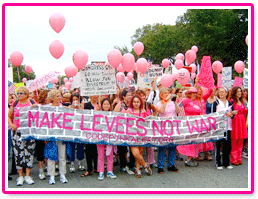
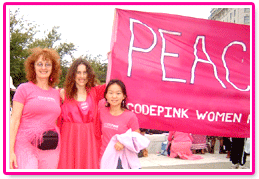
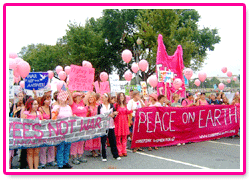
I am too tired to put coherent words together, but here is the one picture my camera took at the peace march before my batteries died...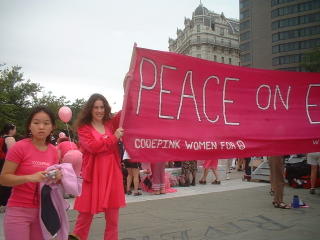 It was actually before the march, right next to the stage at the women's convergence, where Cindy Sheehan and other amazing women spoke and Joan Baez sang. After Medea Benjamin spoke, it was time to head over to the staging area for the march; Medea asked everyone to follow the banner I was holding. I had no idea where to go--luckily, she helped lead the way. It was amazing to be right at the front of a formidable group of women.
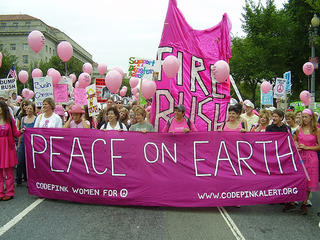 I found these two pictures online. I'm hoping I can wrangle some more from my friends. Here, you can see a sliver of my body on the left side of the frame as we walk to the staging area.
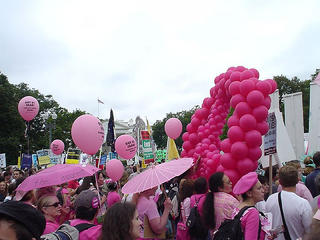 In this one, we're in front of the White House; you can see the side of my face at the bottom of the frame.
More stories soon, after I've had a chance to breathe a little and process everything. I have a feeling I'll be dreaming in pink tonight....
 It was actually before the march, right next to the stage at the women's convergence, where Cindy Sheehan and other amazing women spoke and Joan Baez sang. After Medea Benjamin spoke, it was time to head over to the staging area for the march; Medea asked everyone to follow the banner I was holding. I had no idea where to go--luckily, she helped lead the way. It was amazing to be right at the front of a formidable group of women.
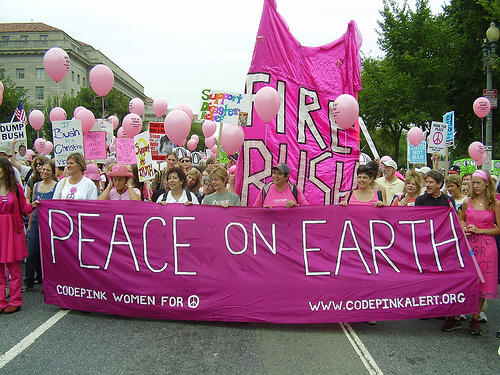 I found these two pictures online. I'm hoping I can wrangle some more from my friends. Here, you can see a sliver of my body on the left side of the frame as we walk to the staging area.
 In this one, we're in front of the White House; you can see the side of my face at the bottom of the frame.
More stories soon, after I've had a chance to breathe a little and process everything. I have a feeling I'll be dreaming in pink tonight....
Monday, September 26, 2005
I'm home from DC, inspired and exhausted, and so grateful I was able to be part of such an amazing mobilization. I don't have time to write a thorough blog entry right now--I have to get ready to teach my class--but you can take a look at some of my impressions about the march over at the CODEPINK blog (scroll down to 9/24).
Thursday, September 22, 2005
Yesterday, my daughter asked if I knew someone was building a statue of Ghandi downtown. She said that she and Matt had been driving down Mission Inn Ave. and had noticed a sign announcing it. I was shocked--a statue of Gandhi in Riverside? In our sleepy, conservative, notoriously-meth-lab-ridden town? It didn't seem possible (although we do happily have a statue of Martin Luther King, Jr. on the Main St. mall.) I drove down Mission Inn Ave myself today, and saw the construction zone with a "Site of Mahatma Gandhi Memorial" placard prominently displayed on the fence. How very, very cool! Gandhi in Riverside!
I did some searching online and discovered that the statue has been in the works for a long while; Lalit Acharya, who founded the Riverside Mahatma Gandhi Peace Foundation (another thing I didn't know existed in our town!), first proposed the memorial after Riverside cops shot a young black woman sleeping in her car, with a gun on her lap, in 1998. He thought the statue would bring a symbol of peace into a community that desperately needed one. Our mayor--who, I must say, is pretty great; he is accessible, and intelligent, and even drives a Prius--agreed to move forward with it. The statue was sculpted in India and is due to be unveiled next month. I am delighted to know that our downtown will soon honor two great heroes of the peace movement. It will make our community peace work all the more resonant.
Speaking of community peace work, I just learned that my hometown, Chicago, recently became the largest American city to officially oppose the war. Yay Chicago! My kind of town.
This weekend, we're going to turn DC into an anti-war zone. I head out early tomorrow morning, and probably won't have a chance to blog again before then; I'm sure I'll have many stories to tell when I return. Have a safe and happy weekend, everyone...
I did some searching online and discovered that the statue has been in the works for a long while; Lalit Acharya, who founded the Riverside Mahatma Gandhi Peace Foundation (another thing I didn't know existed in our town!), first proposed the memorial after Riverside cops shot a young black woman sleeping in her car, with a gun on her lap, in 1998. He thought the statue would bring a symbol of peace into a community that desperately needed one. Our mayor--who, I must say, is pretty great; he is accessible, and intelligent, and even drives a Prius--agreed to move forward with it. The statue was sculpted in India and is due to be unveiled next month. I am delighted to know that our downtown will soon honor two great heroes of the peace movement. It will make our community peace work all the more resonant.
Speaking of community peace work, I just learned that my hometown, Chicago, recently became the largest American city to officially oppose the war. Yay Chicago! My kind of town.
This weekend, we're going to turn DC into an anti-war zone. I head out early tomorrow morning, and probably won't have a chance to blog again before then; I'm sure I'll have many stories to tell when I return. Have a safe and happy weekend, everyone...
Wednesday, September 21, 2005

Today, the Girlfriends Cyber Circuit brings Melanie Lynne Hauser, author of CONFESSIONS OF SUPER MOM, to our doorstep.
The story sounds like great fun:
Birdie Lee is an average hard-working single mother of two teenagers, PTA lackey, and mild-mannered grocery clerk at the local Marvel Fine Foods and Beverages. One morning, while getting ready for work, Birdie is sidetracked by a stubborn Stain of Unusual Origin on her bathroom floor. Unable to let the stain get the best of her, she tries to annihilate it with every household product she can find –to no avail. Angry, hot, light-headed (and forgetting to turn on the exhaust fan), she makes one final desperate attempt to eradicate this vile, dastardly stain: she loads her Swiffer Wet Jet with every household cleanser she owns, aims, and fires….
And passes out, overcome by the fumes. After regaining consciousness (and reminding herself to scrub the bottom of the toilet since from her perspective — flat on her back — it was looking a little dingy), Birdie realizes something’s amiss. Her ears begin to buzz and her senses are aquiver. Eventually, aided by Martin, her geeky thirteen-year-old son and trusty sidekick, Birdie understands that she now possesses extraordinary powers— superpowers, to be exact. Birdie soon learns, however, that, to quote Spiderman, with great power comes great responsibility and she finds herself
struggling to balance a new onslaught of challenges, both at home and in her community. While trying to keep her distant 15-year-old daughter’s heart from being broken (something not even a superhero can do), and dealing with her smug ex-husband and his over-achieving new wife, she must manage her job, PTA responsibilities and a budding romance– all the while trying to rescue her beloved town of Astro Park from an evil force that threatens its children.
The book is receiving all sorts of raves, including this one from Publishers Weekly: "Like its title character, this debut novel has a secret identity...it's unexpectedly poignant and packs an emotional punch despite the cheery veneer... at the heart of this story is a narrative about a lonely, wronged woman who just wants to do right by her children and stand up to an uncontrollable world. Hauser slips in soliloquies on motherhood and womanhood that, though brief, are moving, showing us Birdie Lee's heart and in that, the wishes and dreams of super moms everywhere. "
I had the pleasure of a virtual sit down with Melanie; here's our conversation:
--What inspired you to write Confessions of Super Mom?
I had written two previously-represented novels that made it to the marketing committee level at major publishers, but never sold. These were "quieter" novels, or so said some of the rejection letters! And so one day my agent and I were talking it over and she said something that struck me. We were talking about what it takes to break into publishing today, discussing the concept of "the hook," and she said that maybe people today want their characters in fiction to be larger than life. So later that day I had a eureka moment - I said to myself (and to whoever else happened to be around), "You want larger than life? Then I'm gonna write about a superhero! How much larger than life can you get than that?" And really, it all fell into place; I'd still write about the issues that were important to me as a woman, a mother; the only difference was, I'd write about them from a superhero's perspective.
--Booklist writes: "This silly but fun twist on the superhero tale comes packaged with a socially responsible message about consumerism, but it doesn't get in the way of the high jinks." Did you set out to include a "socially responsible message about consumerism" in your novel, or did this arise as you were writing? Could you share any thoughts about writing and social responsibility?
This arose while I was writing. I had all the elements down - the parts that were pure "women's fiction," the superhero origin - but I didn't have the requisite archnemesis nailed. So when thinking about that subplot, knowing that it would have to somehow endanger children, I eventually hit on a plot to brainwash children, via videogames, into buying patriotic junkfood. Initially I was satirizing a lot of the post 9/11 jingoism. The videogame is about a heavily-armed Abe Lincoln taking out terrorists on top of Mt. Rushmore. But the consumerism angle was a natural extension of this - and I was thinking about how so many things have been wrapped up in the flag, post 9/11, and people don't even stop to think about them. All those magnetic ribbons and flags, for instance, that we see on cars these days. Does anyone think about the people profiting from them? Do they even question their intent? I'd have to say the answer is "no" on both of those counts, and I did want to write about that, just a little. But - and this is a big but - I was determined to wrap up my message not in a flag, but in a joke, a sly wink. I don't think that it's my job to be preachy. It's my job to tell a good story, to entertain, and if there is something under the surface that makes you think, just a bit, that's great. But I wouldn't let that something get in the way of a good story.
--If you could choose a super power, what would it be?
The ability to eat what I want and never, ever, get fat, while at the same time, supermodels would suddenly develop a tendency to pack on pounds just by breathing.
--Any advice for aspiring writers?
Don't get too attached to your work. It drives me nuts to hear authors refer to their manuscripts as their "babies." They're not. They're words. And there's a good chance you'll be able to come up with more of them. Learn to move on to the next project, and the next, and the next after that.
--What's next for Super Mom? And what's next for you?
I'm working on the sequel, which is due in to my editor very soon, and which will be published in 2006. Beyond that, I don't really know - and I haven't had time to really think about it. I'd love to keep writing about Birdie and her family, and the parade of evil villains I have in mind for her, as well as other novels, too.
--I always ask a question about fruit--In your opinion, what fruit has the most super powers, and why?
Blueberries. I don't know why, exactly, other than the fact that I crave them all the time, lately, mixed up with yogurt and granola, and I feel extremely, powerfully, healthy after I eat them.
--Thanks so much, Melanie! May Super Mom's powers (and your own!) continue to flourish...
Tuesday, September 20, 2005
Ever since I wrote the last line of the last post, I've been wondering whether I should delete it, change it, tone it down. I guess that proves the power that certain words can have! And it lays my own tricky relationship with swearing very bare. I see those words, and they don't feel like my own. When I was younger, I used to think I was not cool enough to swear. I was in awe of kids who were able to do so in a nonchalant way; my parents tell me that when I came home from my first day of kindergarten, I said, very excitedly, "I met a boy who can swear with his fingers!" I was so impressed; even at 5, though, I knew it was something that I would never feel comfortable doing. Just like I never feel comfortable saying the catch phrases of the day; they always feel wrong on my tongue, awkward. I'm strangely impressed by people who can easily incorporate new phrases (like the current use of "rocking" as a verb--"she was rocking the blue hair") into their vocabulary and sound like they've been saying them all their lives. It's funny--I try to be expansive and free in my use of language, but I guess I do set certain boundaries up for myself. Maybe they'll come tumbling down and I'll end up cursing like a sailor some day. We'll see. I used to cry whenever I talked about body issues, and now I can talk happily about body stuff to large rooms of people (that, too, is a surprise; when I was a rarely-raise-her-hand-in-class-because-I-was-too-shy girl, I never would have imagined that I'd feel comfortable talking to large rooms). I suppose anything can happen; life is always full of surprises...
The physiology of language has been a long obsession of mine, so it was fun to come across this article about how swear words affect our minds and bodies and culture.
Yesterday, my daughter asked me why I've been swearing so much lately. I didn't realize I had been swearing more--I usually don't swear much at all (it does have a real physical effect on me; my mouth usually feels a resistance to those words)--but I think my emotions have been more raw in the last few weeks, in the aftermath of Katrina, and maybe my guard is down. Hannah could only bring up two examples of times I swore in the last week--once, when someone cut me off on the freeway, and once when Microsoft Word crashed and I lost a bunch of work (nothing too important, thankfully)--but I guess two times is a lot more than zero. Sometimes it feels so good to swear, very cathartic. Maybe if I used curse words more often, they wouldn't have the same impact, the same hair-raising power. Now when I use them, it's like a fucking atomic bomb.
Because cursing calls on the thinking and feeling pathways of the brain in roughly equal measure and with handily assessable fervor, scientists say that by studying the neural circuitry behind it they are gaining new insights into how the different domains of the brain communicate - and all for the sake of a well-venomed retort.
Other investigators have examined the physiology of cursing, how our senses and reflexes react to the sound or sight of an obscene word. They have determined that hearing a curse elicits a literal rise out of people. When electrodermal wires are placed on people's arms and fingertips to study their skin conductance patterns and the subjects then hear a few obscenities spoken clearly and firmly, participants show signs of instant arousal.
Their skin conductance patterns spike, the hairs on their arms rise, their pulse quickens, and their breathing becomes shallow.
Yesterday, my daughter asked me why I've been swearing so much lately. I didn't realize I had been swearing more--I usually don't swear much at all (it does have a real physical effect on me; my mouth usually feels a resistance to those words)--but I think my emotions have been more raw in the last few weeks, in the aftermath of Katrina, and maybe my guard is down. Hannah could only bring up two examples of times I swore in the last week--once, when someone cut me off on the freeway, and once when Microsoft Word crashed and I lost a bunch of work (nothing too important, thankfully)--but I guess two times is a lot more than zero. Sometimes it feels so good to swear, very cathartic. Maybe if I used curse words more often, they wouldn't have the same impact, the same hair-raising power. Now when I use them, it's like a fucking atomic bomb.
Monday, September 19, 2005
I have always been a huge Sharon Olds fan--her poetry is so gorgeous, so raw; her work gave me permission, as a young poet, to write honestly about living in the body. After reading her letter declining Laura Bush's invitation to speak at the National Book Festival in DC, I love her all the more.
Sunday, September 18, 2005

This Friday, I will head to DC for the big peace march and rally. I am so excited. I bought a bunch of pink clothes (including a fun ballerina-style satin and tulle dress) at Goodwill a few days ago so I can be fully CODEPINK-ed out. It should be an amazing few days. Our country is so ready for change. We will show our numbers, share our voices, make sure Washington feels our presence. The peace movement is not a focus group, as Bush called us after the huge worldwide rallies before the war began--we are a focused group, and we will make a difference.
Saturday, September 17, 2005

If you happen to be in LA today, swing on by the LA Farmer's Market. There will be great roots music all day; my husband's band Bucksworth is playing at 4. I don't think of them as a country band, but they're going to be filmed by CMTV for a pilot about alternative country music. Matt and Mark (the amazingly talented lead singer/songwriter) went into LA yesterday to be interviewed for the show; they came home with a bit of camera makeup still on their faces. The concert is free, but donations are welcome, and will go towards hurricane relief. A portion of all CD and merchandise sales will, as well.
Friday, September 16, 2005

I just discovered the Dutch cover for The Book of Dead Birds! According to Babelfish, the title translates into "My Mother's Wings"--how cool is that?! I haven't seen the Dutch hardcover, which was published under the original title: Het boek van de dode vogels. I wonder if the title proved problematic in the Netherlands--I know people either love it or hate the title here, and a lot of people have been scared off by it. My Mother's Wings is more accessible, for sure. And I love the cover--hooray for pelicans!
Thursday, September 15, 2005
Attention all 6-9 year olds! (Actually, attention to all parents of 6-9 year olds, since I doubt many 6-9 year olds are reading this blog...)
I will be teaching a free children's writing workshop, Coming To Your Senses, at 826LA in Venice this Saturday afternoon, from 12-2. 826LA is a wonderful community writing center, sister to 826 Valencia in San Francisco, and other 826s rising up around the country.
Several 826 volunteers have traveled to Houston to provide Katrina evacuees with paper, pencils, art supplies, and other outlets for creative expression. You can read their dispatches here.
I will be teaching a free children's writing workshop, Coming To Your Senses, at 826LA in Venice this Saturday afternoon, from 12-2. 826LA is a wonderful community writing center, sister to 826 Valencia in San Francisco, and other 826s rising up around the country.
Several 826 volunteers have traveled to Houston to provide Katrina evacuees with paper, pencils, art supplies, and other outlets for creative expression. You can read their dispatches here.
Wednesday, September 14, 2005
Novelist Stacey D'Erasmo's recent piece, Flicked Aside by the Universe, is one of the most thoughtful and beautifully written meditations on life after September 11th (and the tsunami and Katrina) that I've come across. Here's a taste:
Two weeks after the disastrous 2004 election, a friend and I were talking about the creeping sense that something else, something we couldn't quite articulate, was larger and even more wrong than the immediate political situation. "I just keep worrying," she said, "about the aquifer."
By which I think she meant not only the literal aquifer, but some force or element that subtends the very ground we walk on. I don't mean God, or even gods. I'm not sure what I mean yet, honestly, as a writer or just as a person, that the customary frame of reality has broken, broken open, over the past four years, that it continues to break. I don't know yet how it will change my work or what other people write or draw or make, this shift in our consciousness of scale. I just know that suddenly, or what seems like suddenly -- now, anyway, since 2001, since water swallowed a good part of the Pacific Rim, since the lights went out all the way to Canada, since New Orleans has become a toxic ghost town, one is more likely to imagine that: the aquifer. Oneself, so much smaller, standing above it, washing dishes, reading, walking. That the aquifer has a life that may or may not include you.
Tuesday, September 13, 2005
Please consider adding your voice to these two actions:
One Million Reasons to Stop the War in Iraq (the reasons will be delivered to the White House on September 26th.)
Protest the upcoming trial of Turkish author Orhan Pamuk.
Here is the email I just sent, using talking points from International PEN. Feel free to use the email as a template for your own letter:
Prime Minister Racep Tayyip Erdogan
TC Easbaskanlik
Ankara
Turkey
Fax: +90 312 417 0476
Cemil Cicek
Minister of Justice
TC Adalet Bakanligi
Ankara
Turkey
Fax: + 90 312 417 3954
One Million Reasons to Stop the War in Iraq (the reasons will be delivered to the White House on September 26th.)
Protest the upcoming trial of Turkish author Orhan Pamuk.
Here is the email I just sent, using talking points from International PEN. Feel free to use the email as a template for your own letter:
To: contact@turkishembassy.org, turkish.emb@btclick.com, turkishottawa@mfa.gov.trYou can also contact
Subject: Orhan Pamuk
Dear Ambassadors:
I am dismayed by the fact that Turkish author Orhan Pamuk is going to be tried for a statement made in an interview for an overseas publication. This is in direct contravention of the United Nations Covenant on Civil and Political Rights, and the European Convention on Human Rights, to which the Turkish government is a signatory. The decision to bring Orhan Pamuk to trial is a travesty. Pamuk is a brilliant writer and a gift to the world, and should not be forced to stand trial for his words. Please reconsider the actions of the Turkish government.
Thank you.
Sincerely,
Gayle Brandeis
Prime Minister Racep Tayyip Erdogan
TC Easbaskanlik
Ankara
Turkey
Fax: +90 312 417 0476
Cemil Cicek
Minister of Justice
TC Adalet Bakanligi
Ankara
Turkey
Fax: + 90 312 417 3954
Monday, September 12, 2005
I had the pleasure today of hearing Medea Benjamin speak. Even though she and I have written together, we had never met each other in person. It was so inspiring to be in her presence. Not only did she give an amazing talk about how to build the peace movement, she also walked her talk. A man in the audience was being disruptive and belligerent (even though he professed to agree with everything she said); when he asked her what specific steps she would take to enact change, and then asked her to hurry with her answer because he needed to go to lunch, she said, very pointedly, something to the effect of "The first thing we need to do is be kind to one another and respect one another's voices." He had berated an earlier attendee for taking too long to ask a question, so this was a direct hit, kind but firm. The room broke into applause and the man stormed away using his walker (the talk was held at a religious, social-justice-focused retirement community in Claremont.) She handled it--just as she handled being dragged out of both the Republican and Democratic National Conventions--with great grace.
Several people from Riverside were there, which was wonderful; it's been great to see the peace movement grow within our conservative town. If any of you are in the area, please keep October 15th open. It is the night my friend Nancy and I are hosting Inspire Hope 2: Riverside Responds to Hurricane Katrina. The fundraiser will feature live music, belly dancing, poetry, and more, and will take place at Back to the Grind, 3575 University Ave., at 6:30pm. If you are interested in performing, please let me know.
Several people from Riverside were there, which was wonderful; it's been great to see the peace movement grow within our conservative town. If any of you are in the area, please keep October 15th open. It is the night my friend Nancy and I are hosting Inspire Hope 2: Riverside Responds to Hurricane Katrina. The fundraiser will feature live music, belly dancing, poetry, and more, and will take place at Back to the Grind, 3575 University Ave., at 6:30pm. If you are interested in performing, please let me know.
Sunday, September 11, 2005
Debra Hamel invited me to recommend three books for the October edition of Buy a Friend a Book Week (her wonderful book-karma brainchild). You can read my choices here. What book will you buy for a friend next month?
Today is the 18th anniversary of the day my husband and I met one another. Until 2001, September 11th was always a glowing day on the calendar. That date, spoken out loud, has such a different feel to it now. I wrote an essay about this shortly after the attacks of 9/11. You can read it here.
My commentary, Burning, Flooding, on what our administration can learn from the Burning Man festival, is up on Common Dreams.
Subscribe to:
Posts (Atom)