I just finished the first draft of my new novel. I am kind of stunned. I never thought I'd get through this draft. I think I've struggled with writing this story more than any other--struggled with finding the time, the focus, struggled with connecting with the characters--but somehow it all came together. I still have a lot of work ahead of me, but at least the story is complete. The revision process should be a lot of fun--I look forward to crafting this sketchy mass into something more alive.
My time at VCCA definitely helped me reconnect with my novel, but once I got home, I lost a lot of momentum. It's just been in the last week that the words really started to flow again, that I really started to feel engaged. I was up until 4 several nights this week, the novel full of steam.
One thing that helped, too: almost losing it all. A few days ago, I remembered that I hadn't backed up the manuscript for a while. I went to copy it into my USB drive, and suddenly the file disappeared, on both my hard drive, and the external disc. It simply disappeared. When I went back to Word and attempted to open it under recent files, I was told that the path was invalid. I thought it was gone forever. I had a physiological melt down--my heart was pounding a million miles an hour, and my hands and face fell asleep, and I could barely breathe. Hannah came into the room when I was on my knees on the floor, yelling and crying. Now that I was finally on a roll, finally almost done, the whole story had vanished! Hannah was very worried, but she kept a calm head and asked if I had checked "Search." I had not. And I did. And I found the file in some strange place--blessedly intact. The experience helped me appreciate the work I had done, even though much of it felt forced as I was writing.
I told Hannah she saved my life, and she told me that for that, I should dedicate the book to her. I think I will do just that.
Saturday, January 06, 2007


Friday, December 29, 2006
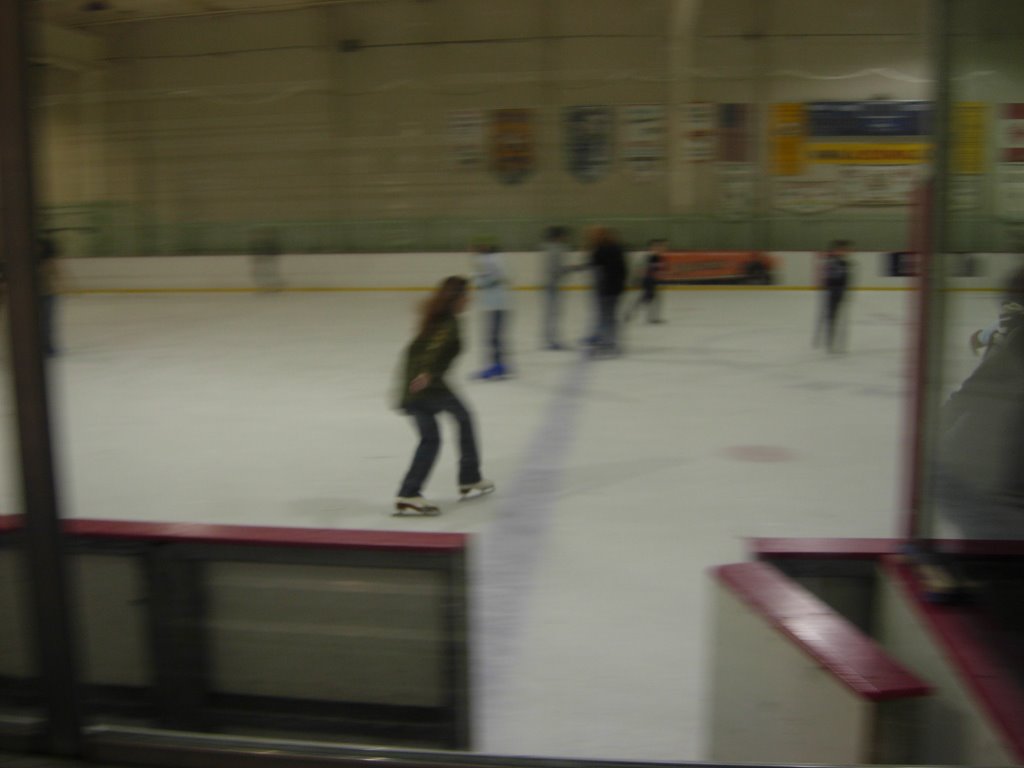 Hannah wanted to go skating for her birthday, so we took her and five friends to the local rink.
When I was young, I was a figure skater. I started when I was five, and skated like a fiend until I was thirteen. My sister and I were in two ice shows every year--The Nutcracker on Ice every December, and a big revue in the Spring. We also competed in local and regional competitions and came home with our fair share of ribbons and trophies. Skating was a huge part of my life; for a couple of years, we skated almost every day after school and some days before (for some reason, I have a very clear memory of waking up for an early session one morning, crumbling some chocolate chip cookies into cereal bowls for me and my sister, pouring milk over them, and telling my mom we were eating Quaker 100% Natural cereal. I recall thinking that the extra sugar would help give us more energy for our skating.)
Every session of skating club would start with an hour of figures (or "patch" as we called it, since each skater was assigned a patch of ice to practice our figure 8s). I enjoyed the hush of the rink during figures, the slice of the blades on ice, the whir of the scribe (the big compass that we used to trace circles on the ice that we'd try to follow with our blades--or that we'd use to measure how close to a circle we were able to get on our own.) After the quiet, focused hour, we'd change into our freestyle skates (which had different blades, with an extra toepick) for an hour of jumping and spinning and footwork, for practicing our routines, and working with our coaches, and going as fast as we possible could, the air cold and sharp in our noses, eyes watering, hair flying back like streamers.
I can't begin to do the double jumps and intricate spins of my youth, but getting on the ice still feels like home to me, like freedom. You can see my edges blurring in this picture, my skates edging me toward flight.
Somehow this study that concludes housework cuts the risk of breast cancer smacks of propaganda to me. Then again, I am one who says yes to mess (I love this article. Here's a taste:)
I am a fan of entropy. I like to see how things unfold, evolve (sometimes devolve) over time. I remember my Physics for Poets professor said that entropy is very powerful because it's the way of nature--things fall apart, then find a new sort of order. It's the whole cycle of creation and destruction. "That's why it's so hard to keep your room neat," he told the class. "You have to work against entropy. It's a losing battle." I prefer working with entropy. It's much more interesting and comfortable (and it definitely saves time.) Not that I live (or want to) in squalor and filth--I just don't mind a cozy jumble. Every once in a while, I get self-conscious about clutter--especially if someone shows up at my house unannounced--but the feeling tends to pass pretty quickly.
I know some people who find cleaning to be meditative, relaxing, empowering. And that's wonderful for them. It's like with writing--everyone has to find their own best process, their own path to bliss. It's so individual. And I know my own personal path to bliss (and health) doesn't require a feather duster.
Mess is robust and adaptable...as opposed to brittle, like a parent’s rigid schedule that doesn’t allow for a small child’s wool-gathering or balkiness. Mess is complete, in that it embraces all sorts of random elements. Mess tells a story: you can learn a lot about people from their detritus, whereas neat — well, neat is a closed book. Neat has no narrative and no personality (as any cover of Real Simple magazine will demonstrate). Mess is also natural, as Mr. Freedman and Mr. Abrahamson point out, and a real time-saver. “It takes extra effort to neaten up a system,” they write. “Things don’t generally neaten themselves.”I used to think that one day I would be more organized, more neat (and therefore more "grown up"), but I have pretty much resigned myself to the fact that that's not going to happen.
I am a fan of entropy. I like to see how things unfold, evolve (sometimes devolve) over time. I remember my Physics for Poets professor said that entropy is very powerful because it's the way of nature--things fall apart, then find a new sort of order. It's the whole cycle of creation and destruction. "That's why it's so hard to keep your room neat," he told the class. "You have to work against entropy. It's a losing battle." I prefer working with entropy. It's much more interesting and comfortable (and it definitely saves time.) Not that I live (or want to) in squalor and filth--I just don't mind a cozy jumble. Every once in a while, I get self-conscious about clutter--especially if someone shows up at my house unannounced--but the feeling tends to pass pretty quickly.
I know some people who find cleaning to be meditative, relaxing, empowering. And that's wonderful for them. It's like with writing--everyone has to find their own best process, their own path to bliss. It's so individual. And I know my own personal path to bliss (and health) doesn't require a feather duster.
 My daughter turned 13 on Wednesday. So amazing that both of my kids are teenagers now, that I'm the mother of teenagers. How did that happen?! I can so vividly remember being 13, myself (although part of me wishes I couldn't. I know 13 will be a much better year for Hannah than it was for me.)
Happy birthday, my sweet, smart, funny, beautiful, talented girl.
Friday, December 22, 2006
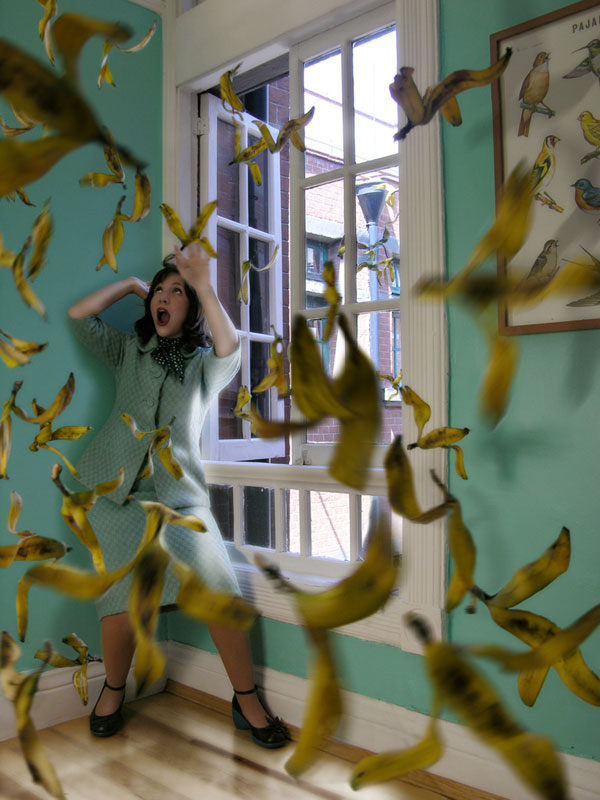
Life is B-A-N-A-N-A-S right now (thanks to Kit Stolz for alerting me to this wonderful image!) but I thought I'd take a moment to touch base and wish everyone a joyous and decidedly non-banana-like holiday season (unless, of course, that is what you are hungry for!)
Some fun Self Storage news...You can also find the book in the January issue of Redbook (recommended on the same page as my friend Laura Ruby's new book, I'm Not Julia Roberts!) Here is what they have to say
Self Storage doesn't hit stores until January 23, but Bookreporter is giving 10 free advance copies away to people who would like to preview the book and comment about it on their website. You can find out more here.Celebrate Yourself.
Flan Parker's Children and friends mean everything to her, but she still yearns to find her own place in a confused, fearful post-9/11 world. Guided by the words of her favorite poet, Walt Whitman, Flan sets off on a surprising journey of self-discovery in Gayle Brandeis's witty and heartwarming novel, Self Storage.
Happy holidays, everyone! Hope they're warm and delicious and meaningful for all of you.
Monday, December 18, 2006
I never considered my writing glamorous before--and I still don't see it that way, but I suppose I can call it Glamor-ous now, since I'm reviewed in the Jan 2007 issue of Glamour Magazine! I just picked up the copy today. It's great fun to see my book recommended on the same page as Gwen Stefani's new album and Naomi Watts' new movie!
Here's the text (under the headline 2 LOST WOMEN, 2 MUST-READ NOVELS--the other novel mentioned is Vendela Vida's Let the Northern Lights Erase Your Name):
(And for other burqa-related writing, check out this cool essay at Nerve.com; it finds parallels between burqa-wearing and recent celebrity waxed-nether-regions flashings!)
Here's the text (under the headline 2 LOST WOMEN, 2 MUST-READ NOVELS--the other novel mentioned is Vendela Vida's Let the Northern Lights Erase Your Name):
Self Storage by Gayle BrandeisPretty cool, huh?!
Flan Parker's life has spun out of control. But when she hides a burka-clad neighbor from vigilantes post-9/11, she finds the strength to help herself.
(And for other burqa-related writing, check out this cool essay at Nerve.com; it finds parallels between burqa-wearing and recent celebrity waxed-nether-regions flashings!)
Friday, December 15, 2006
One more quick blog about place. I recently discovered Poetry Thursday. It's such a great concept; the hosts post a writing prompt every Sunday, and then anyone who wants to can play with the prompt and post the resulting poem on their blog on Thursday. This week, the site suggested being inspired by a street. I am cheating a bit--this is a poem I wrote several years ago, and today is Friday, not Thursday, but I hope to participate in future prompts on a more timely basis.
The poem, Sheridan Square, honors the street I grew up on in Evanston, IL, right on the border of Chicago. You can see it on Google Maps here.
Sheridan Square
It wasn't a square, really,
just half of one,
the L-shaped street
I grew up on.
I loved saying I lived
on an L-shaped street;
maybe that's where my love
of letters grew from,
living on the forearm
of those two perpendicular lines,
lines that instantly lulled me
as I turned the corner
at the green mail box
on the way home from school,
the L bent like an elbow,
holding me close
to the heart of my life.
The poem, Sheridan Square, honors the street I grew up on in Evanston, IL, right on the border of Chicago. You can see it on Google Maps here.
Sheridan Square
It wasn't a square, really,
just half of one,
the L-shaped street
I grew up on.
I loved saying I lived
on an L-shaped street;
maybe that's where my love
of letters grew from,
living on the forearm
of those two perpendicular lines,
lines that instantly lulled me
as I turned the corner
at the green mail box
on the way home from school,
the L bent like an elbow,
holding me close
to the heart of my life.
Please forgive my lapse in blogging lately--it's such a crazy time of the year. I wish I had had the foresight to post about my local readings in the last week for the wonderful new anthology Inlandia: A Literary Journey through California's Inland Empire
I've lived in the "Inland Empire" for 20 years--it is a much-maligned, misunderstood part of Southern California. I doubt David Lynch's new fever dream of a movie, Inland Empire, is going to change that in any way--a review in the New York Times made reference to the "bleak Southern Califonia region" of the movie's title. And yes, the Inland Empire is bleak in places, but it's also beautiful and wild and complicated and growing, and, as the back of Inlandia notes, it's a "breeding ground for passionate literature." The book features a diverse mix of poetry, fiction and creative non-fiction, from Joan Didion, John Steinbeck, MFK Fisher, Mike Davis, Laura Kalpakian, Susan Straight, Alex Espinoza, Michael Jaime-Becerra, and many other voices (including an excerpt from my novel, The Book of Dead Birds.) I am very grateful to Heyday Books for honoring this adopted home of mine, for celebrating it through the written word, for helping people begin to understand the majesty of this often misread place.
I've lived in the "Inland Empire" for 20 years--it is a much-maligned, misunderstood part of Southern California. I doubt David Lynch's new fever dream of a movie, Inland Empire, is going to change that in any way--a review in the New York Times made reference to the "bleak Southern Califonia region" of the movie's title. And yes, the Inland Empire is bleak in places, but it's also beautiful and wild and complicated and growing, and, as the back of Inlandia notes, it's a "breeding ground for passionate literature." The book features a diverse mix of poetry, fiction and creative non-fiction, from Joan Didion, John Steinbeck, MFK Fisher, Mike Davis, Laura Kalpakian, Susan Straight, Alex Espinoza, Michael Jaime-Becerra, and many other voices (including an excerpt from my novel, The Book of Dead Birds.) I am very grateful to Heyday Books for honoring this adopted home of mine, for celebrating it through the written word, for helping people begin to understand the majesty of this often misread place.
Tuesday, December 05, 2006
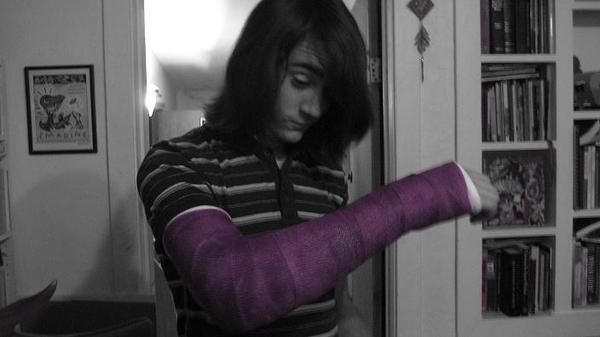
You can read about (and see a picture of!) one of my bookcases--the very bookcase I'm looking at from my desk, in fact--at The Librarian's Own Grove (the Riverside Public Library's lovely new blog.) Arin's purple cast is pointing to a corner of the same bookcase here:
Monday, December 04, 2006
My son fractured his wrist Friday night--a scaphoid fracture, which apparently is difficult to heal. Today, an orthopaedist fitted him with a full arm cast (a purple one--Arin's color choice.) He's going to have to wear it for 3 or 4 months, possibly longer. My poor skateboarding, guitar-playing boy. He's taking it all in great stride; I think the news was harder for me. As the doctor explained how the injury happened right where the artery supplies blood to the hand, and if the bone is displaced, it will cut off the blood supply in the hand and bones will start dying inside him, I started to feel dizzy. Arin and I had been joking earlier about the little vials of smelling salts taped to the cabinets in the room, but I began to think I might actually need one of them. I always get a little light headed when anything happens to either of my kids.
Arin had to take off his long sleeved shirt to accomodate the cast. We were in a room divided into two exam areas; the two women--one probably in her late 30s and her mother--waiting in the adjacent area couldn't take their eyes off Arin's bare chest. The older woman actually took a few steps closer to get a better look. So interesting to see women staring at him that way (although I don't blame them; he is a gorgeous 16 year old guy.) I looked at Arin's shoulders, and remembered a portrait of him from when he was about 6 weeks old. A photographer came to our house to take pictures, and propped Arin up, his little arms crossed on top of the cushion in front of him. His shoulders looked so burly for a baby as he rested on his elbows, so well muscled and defined, lightly feathered with hair. They look almost just the same now, only on a much larger scale. My baby, almost all grown up.
I think of Arin's hand bones, shoulder bones, forming inside my belly, and it makes me dizzy again to think of anything happening to any sweet part of him.
I was recently asked to read two novels in manuscript. In both of them, women lose their sons when they are young men (one dies of an overdose; the other dies in an accident after being kidnapped in Africa.) I have been feeling such sharp stabs of loss as I read these beautifully written stories. They remind me that Arin's skateboard accident could have been so much worse. Still, his injury can't help but drive home how fragile life really is, how the world as we know it can change in one swift moment, how we need to hold those we love close to our hearts because we don't know how long we'll get to keep them there.
Arin had to take off his long sleeved shirt to accomodate the cast. We were in a room divided into two exam areas; the two women--one probably in her late 30s and her mother--waiting in the adjacent area couldn't take their eyes off Arin's bare chest. The older woman actually took a few steps closer to get a better look. So interesting to see women staring at him that way (although I don't blame them; he is a gorgeous 16 year old guy.) I looked at Arin's shoulders, and remembered a portrait of him from when he was about 6 weeks old. A photographer came to our house to take pictures, and propped Arin up, his little arms crossed on top of the cushion in front of him. His shoulders looked so burly for a baby as he rested on his elbows, so well muscled and defined, lightly feathered with hair. They look almost just the same now, only on a much larger scale. My baby, almost all grown up.
I think of Arin's hand bones, shoulder bones, forming inside my belly, and it makes me dizzy again to think of anything happening to any sweet part of him.
I was recently asked to read two novels in manuscript. In both of them, women lose their sons when they are young men (one dies of an overdose; the other dies in an accident after being kidnapped in Africa.) I have been feeling such sharp stabs of loss as I read these beautifully written stories. They remind me that Arin's skateboard accident could have been so much worse. Still, his injury can't help but drive home how fragile life really is, how the world as we know it can change in one swift moment, how we need to hold those we love close to our hearts because we don't know how long we'll get to keep them there.
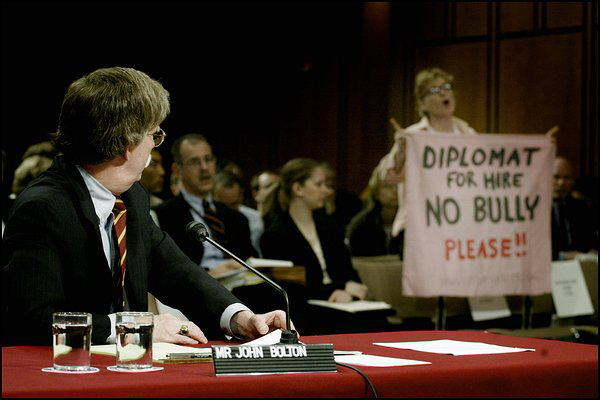 Hooray for Bolton's resignation! I love this picture of CODEPINK's Gael Murphy speaking truth to power during one of Bolton's hearings--I am forever indebted to her and Medea and Jodie and all the other CODEPINKers who dare to ask for peace (and are often dragged away as a result!)
Sunday, December 03, 2006
Janis Cooke Newman shares ten things she knows about writing. I particularly like the second item on her list:
I still haven't read Newman's book, Mary. I am very eager to do so.
For another perspective on writing, here is an Author's Prayer from Ilya Kaminsky. I especially love these lines:
That's how reading and writing often feel to me, like slipping into something comfortable that feels like infinity.
2) Every scene has a mood, and everything in that scene should contribute to that mood. Just as in poetry, where each word counts, each sensory detail, description, and image should work to evoke the mood you intend. Nothing you put in a scene should be arbitrary — every word should count towards creating the overall tone.Yes (although these issues come in to the picture during revision for me, not during the initial writing, when I am usually not very conscious of what I'm doing). I am not sure how I feel about the next item on her list, which talks about manipulating the reader's emotions. I try not to think of the reader as I write. I try to not have an agenda or be manipulative in any way (although I often do feel manipulated by my characters--they toss me all over the place.) I am in awe of writers who have a handle on the tone and effect of their work; it tends to be a big mysterious mush for me.
I still haven't read Newman's book, Mary. I am very eager to do so.
For another perspective on writing, here is an Author's Prayer from Ilya Kaminsky. I especially love these lines:
I must write the same poem over and overI went to my montly poetry group tonight. I love meeting with this group of poet women--all of them are so talented and insightful and fun to hang out with. One woman, Lavina Blossom (an amazing name, yes?) shared a prose poem that holds one of the greatest sentences I've read in a long time: "As for me, I seemed to be slipping into something comfortable that felt like infinity."
for the empty page is a white flag of their surrender.
If I speak of them, I must walk
on the edge of myself, I must live as a blind man
who runs through the rooms without
touching the furniture
That's how reading and writing often feel to me, like slipping into something comfortable that feels like infinity.
Sorry I've been in non-blogging mode--life has been ultra-consuming lately. Until I get around to posting again, here are my latest CODEPINK alerts:
Give the Gift of Peace
Remembering Iraqi Women
Hope you're having a happy December (how is it December already?!)...
Give the Gift of Peace
Remembering Iraqi Women
Hope you're having a happy December (how is it December already?!)...
Tuesday, November 21, 2006
A couple of weeks ago, my wonderful brother and his equally wonderful wife were in town; Jon is producing a show about Middle Eastern music for PBS, and he brought several of the musicians to the States to perform at the Roxy Theater in Hollywood. It was an exciting, diverse program--everything from Lebanese hip hop to Egyptian street music to haunting Arabic ballads. We met several of the musicians, including Ilham Al Madfai, a guitarist whose family had to make a swift escape from Iraq after his teeange son became the target of Uday Hussein's wrath. It was very moving and humbling to hear the musicians' stories; it reminded me that sharing our tales, sharing our culture, our art, is such a beautiful and important way to build bridges, to realize the Other is not really other at all. Our culture, of course, has developed a nasty habit of demonizing anyone from the Middle East; just today, a group of Muslim clerics were asked to leave a plane because they made one of the other customers uncomfortable. Such intolerance has become frigteningly pandemic. I am grateful to my brother for bringing these musicians to an American audience, for reminding the American people that we're all humans sharing this planet.
After the concert, my family got into a van along with Lebanese singer/songwriter Tania Saleh and her band to head back to the hotel. A wildeyed man who looked a little bit like a dirty and disheveled Santa Claus had been hanging around the front of the theater, pushing his bicycle, chanting something about Death. My daughter was getting very freaked out by him as we stood on the sidewalk, and was relieved when the van arrived and we were able to get inside. The man, however, proceeded to get into a tussle with one of the musicians still standing outside, and ended up opening the van door right next to my daughter and lunging toward her with all his anti-Santa-Claus rage. She jumped across my lap, screaming--I've never seen her move so quickly before. Thankfully someone was able to pull the man away, and we shut and locked the door before he could get back in.
My daughter was deeply shaken, of course. I was so moved to see how this group of Lebanese musicians--men who might be mistaken for terrorists by ignorant Americans--worked to calm her down. One of the men asked her her name. When she said Hannah, he asked if she knew that it was an Arabic name. Hannah shook her head--we had only known it as a Hebrew name. Hannah means "happiness" in Arabic, he told her. "Be your name," he said with a gently teasing smile. He was able to get her to stop hyperventilating, get her to relax, even laugh.
It is direct experiences like this one that can really break down preconceptions and help us as human beings open our hearts to one another. We need more cultural dialogue like this, more avenues toward understanding. I am so glad my brother and his wife built this bridge of music; the show will probably air sometime in April--I will be sure to share the information when the time draws near.
After the concert, my family got into a van along with Lebanese singer/songwriter Tania Saleh and her band to head back to the hotel. A wildeyed man who looked a little bit like a dirty and disheveled Santa Claus had been hanging around the front of the theater, pushing his bicycle, chanting something about Death. My daughter was getting very freaked out by him as we stood on the sidewalk, and was relieved when the van arrived and we were able to get inside. The man, however, proceeded to get into a tussle with one of the musicians still standing outside, and ended up opening the van door right next to my daughter and lunging toward her with all his anti-Santa-Claus rage. She jumped across my lap, screaming--I've never seen her move so quickly before. Thankfully someone was able to pull the man away, and we shut and locked the door before he could get back in.
My daughter was deeply shaken, of course. I was so moved to see how this group of Lebanese musicians--men who might be mistaken for terrorists by ignorant Americans--worked to calm her down. One of the men asked her her name. When she said Hannah, he asked if she knew that it was an Arabic name. Hannah shook her head--we had only known it as a Hebrew name. Hannah means "happiness" in Arabic, he told her. "Be your name," he said with a gently teasing smile. He was able to get her to stop hyperventilating, get her to relax, even laugh.
It is direct experiences like this one that can really break down preconceptions and help us as human beings open our hearts to one another. We need more cultural dialogue like this, more avenues toward understanding. I am so glad my brother and his wife built this bridge of music; the show will probably air sometime in April--I will be sure to share the information when the time draws near.
Sunday, November 19, 2006

Friday, November 17, 2006
The amazing David Abrams graciously invited me to be a guest blogger on AgathaChristie.com, where he writes a regular blog about Christie's work. You can read how her books helped me through a dark period of my life here.
Wednesday, November 15, 2006
Self Storage got such a lovely review from Booklist:
The Book of Dead Birds (2003), Brandeis’ debut, won Barbara Kingsolver’s Bellwether Prize. In her second brisk, covertly trenchant novel, Brandeis manages to weave Walt Whitman, 9/11, and secondhand goods into a provocative story about the nature of one’s self and the intrinsically human need to find meaning in life. Flannery cherishes an old edition of Leaves of Grass, her only bequest from her long-deceased mother. With Whitman as her spiritual guide, she lives hand-to-mouth with her soap-opera-addicted graduate-student husband, high-strung young son, and escape-artist toddler daughter in a Riverside, California, enclave for international scholars. To make ends meet, Flan buys and resells the auctioned-off, memory-laden contents of abandoned self-storage units. As though life isn’t precarious enough, Flan is drawn into a high-stakes drama involving her burka-wearing Afghan neighbor, the target of prejudice and hate crimes. Executing a marvelous narrative sleight of hand, Brandeis uses slyly insouciant humor and irresistible characters to delve into the true significance of neighborliness, advocate for doing the right thing, and celebrate a Whitmanesque embrace of life. ––Donna SeamanI am very grateful.
Monday, November 13, 2006
Until I have time to post a real blog, you can find me in a couple of places:
NPR's Novel Ideas: How Writers Create Their Fiction (scroll down to the bottom of the page)
and
an interview at Mom Writers Literary Magazine
How about them elections, by the way?! I am still beaming.
NPR's Novel Ideas: How Writers Create Their Fiction (scroll down to the bottom of the page)
and
an interview at Mom Writers Literary Magazine
How about them elections, by the way?! I am still beaming.
Tuesday, November 07, 2006
Happy Election Day, everyone! Please be sure to Give Peace a Vote.
Here is a handy progressive voting guide for those of you in California.
We have the chance to make some real change today--I am feeling very hopeful.
Here is a handy progressive voting guide for those of you in California.
We have the chance to make some real change today--I am feeling very hopeful.
If you want to know what I was reading at the Virginia Center for Creative Arts, you can read my dispatch over at Critical Mass, the blog of the National Book Critics Circle.
Thursday, November 02, 2006
It is my great pleasure today to welcome Donna Druchunas to Fruitful. Donna is currently on a blog tour to promote her new book, Arctic Lace. I asked her to share how she weaves together writing and knitting and social responsibility (a mix that is central to her life). Here is her beautiful and inspiring response:Hi Gayle,
Thanks so much for inviting me to post a guest entry on your blog. I am very excited to talk about social responsibility and how it relates to my writing and knitting. It’s something that I think we writers forget about sometimes, when we get sucked into the rat race of book sales or we focus too much on using our writing solely to fulfill our own creative needs.
When I first thought about writing my second book, Arctic Lace, my goals were basically selfish. I had read an article about a group of 200 Native Alaskan women who knit delicate lace using fur from the arctic musk ox. I wanted to know more. I wanted to read a book on the subject, but it didn’t exist! So I set off on a journey to follow my obsession with the story. I thought it would be straight forward and I would write a “normal” knitting book about my discoveries.
However, as I worked through my research, and especially as I traveled in Alaska in 2004, I began to realize that there was a lot more to this story than I originally anticipated. Not only is it the story of a unique style of knitting and an unusual type of yarn, but it is the story of empowering women, of protecting the environment, and of appreciating and preserving cultures that differ from the mainstream.
When the Musk Ox Project, as it was first called, began in the 1950s, it was headed by a Vermonter named John Teal who had a vision to domesticate the musk ox and to create a cottage industry that would provide income to Native Alaskan people living in rural villages. At the time, the only job available to most women was to be a man’s secretary. Several of the women who were very influential in the birth and development of the Oomingmak Musk Ox Producers’ Co-operative, as it came to be known when it was incorporated, were hired as secretaries. Today, however, the co-op’s director is a woman, most of the people who work in the retail shop are women, and the Musk Ox Farm’s manager is a woman. My how things have changed! But the lack of economic opportunities that provide independence for women is still a huge problem around the world.
In Eskimo villages around Alaska, life for women is more difficult than it is for those of us who live in cities, suburbs, and even in rural towns in the lower 48. Because the villages are so remote, the cost of every-day items is outrageously high. When I visited Unalakleet, a village of 600 on the West coast of Alaska, I went to the general store and did some comparison shopping. A pack of hot dogs cost $7, a gallon of milk, $6.99, a quart of apple juice, $4.59, and one pound of low-quality chop meat cost $3.49. In addition, most of the food available was processed and frozen, and the selection of fresh, healthy items was all but non-existent. At the same time, jobs are scarce, often seasonal, and usually go to men first. This is true all over the Yukon Kuskokwim River Delta, where most of the knitters from the Oomingmak Co-op live. With so few opportunities to make money and little healthy food available for sale even at high prices, the people there still depend primarily on traditional food gathering techniques for their survival.
Most of the Yup’ik people who live in the delta want to preserve their Native traditions and live off the land, but that does not eliminate the need for cash. Today snow mobiles have largely replaced dog teams for winter transportation and aluminum fishing boats have replaced kayaks for summer travel. Both of these vehicles run on purchased fuel. Traditional fur parkas have been replaced by modern Polar Fleece and ready-to-wear winter clothing. Indoor plumbing, heated houses, and computers have become necessities of life in Eskimo villages, just as they have for the rest of us. These are just a few examples of how modern technologies are being incorporated into the traditional subsistence lifestyle. And all of these things cost money.
Knitting gives women in these villages the ability to make money while they travel to fish camps and berry picking areas in the summer, preserve food for the coming winter each fall, and care for young children or elders throughout the year. (There have been a few male knitters in the co-op but none are actively involved today.)
Traditional Yup’ik society was much more egalitarian than today’s capitalist culture. Wealth was often redistributed at annual feasts and ceremonies, and families took care of one another in a way that is not common in modern American society. The changes that have come, in many places just over the past 40 or 50 years, have not been easy for many Eskimo people to accept. They struggle to maintain the important aspects of their culture while adopting modern tools to help them gain a stronger political voice and to make life easier for themselves and their children.
One of the most basic values of the Yup’ik people is the protection of the environment. A core philosophy is to make sure that any decision made and any action taken is not only right for the current moment, but also for the future of the next seven generations. It is often difficult for the older Native people to understand how the actions of those of us so far away in the lower 48 and around the world can impact their environment so destructively. And yet they stand almost powerless as they watch the polar ice melting and the sea swallowing their villages. At least two of the member villages of the Oomingmak Co-op will have to be moved due to erosion caused by global warming. In addition, the loss of polar ice disrupts the food chain, as marine mammals are forced to change their normal migration paths. While politicians in Washington ignore the scientific data that does not support their ideology or the goals of corporate lobbyists, Native Alaskans are watching their lives and livelihoods being washed out to sea.
In addition, the musk oxen that provide the fiber for the Oomingmak knitters, are not suited to living in warm climates. The animals evolved to live in a frigid, arid climate and they can overheat in temperatures as low as 70 deg F. They also cannot survive in deep or wet snow. Their hooves are suited to dig only through shallow snow to find food in winter, and they are so well insulated that if they are caught sleeping in an icy storm they can be frozen to the ground and die. With the climate in the arctic changing at a much faster rate than in other parts of the world, the future of the musk ox is, at best, in jeopardy.
As I learned about these things through my research, I decided I would have to incorporate all of these ideas into my book or I would be selling my readers short. Although some of the topics I discuss can be controversial, and I might have been advised that to talk about these things could diminish my book sales, I decided that I had to speak the truth that I learned.
***
Here are a few links for those who would like to help the Oomingmak knitters or other socially-conscious knitting related groups:
The Oomingmak Musk Ox Producers’ Co-operative sells unique hand knitted items, knitting kits, and musk-ox related gifts. The profits of the co-op are distributed annually to member knitters. A portion of my royalties for Arctic Lace also go to the co-op, and the book can be purchased directly from them, as well as at local yarn and book shops around the country.
Lantern Moon is an organization that sells beautiful and functional handcrafted products that provide income, education and self-reliance to Vietnamese women and their families.
Mango Moon sells recycled yarns and other products that help provide income and independence to women in Nepal.
Himalaya Yarn is a small company offering mostly handspun and hand-dyed yarns made with recycled and Nepal-grown fibers. The company provides business opportunities for local people. For instance, its recycled silk yarn is handspun by women’s cooperatives and the profits support women’s shelters and programs.
Wednesday, November 01, 2006
Good luck to everyone embarking upon National Novel Writing Month! I am not going to register this year, but I am going to try to keep up with the NaNo word count (around 1700 words a day) and see if I can finish the first draft of my novel-in-progress this month. After my time in Virginia, it feels do-able. We shall see...
Subscribe to:
Posts (Atom)